*****
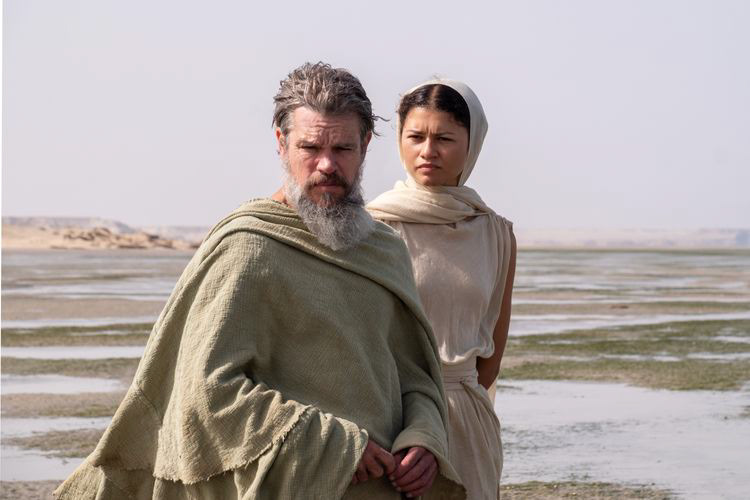
The Odyssey is a big film. It’s long, and full of extended, dramatic episodes in the return of Odysseus (Matt Damon) from the Trojan War to his home in Ithaca, where his wife, the long suffering Penelope (Anne Hathaway) and son Telemachus (Tom Holland) are faithfully waiting, unsure whether the heroic traveller/warrior, 'the man who won the Trojan War' is still alive. It is an epic film dealing with an epic story, one of the most imaginative creations in all literature. The hazards, the creatures, the jeopardies are fantastical, memorable and convincing, in Homer’s version and, to his credit, in Nolan’s version too. The scene with Polyphemus the one-eyed Cyclops is particularly haunting, and Samantha Morton’s Circe, transforming Odysseus’ comrades into pigs is a touch of brilliance. As is the scene in which Odysseus arrives at Hades to consult with the prophetic Tiresias – a masterful touch.
The cast reads like a Who’s Who of the red carpet. They all shine. Damon, with his troubled, ageing, knowing character lines leads the plot. Hathaway and Holland complete the family. There are other flashes of excellence. Helen, the face that launched a thousand, or perhaps 500 ships, Menelaus tells Telemachus, as he reveals his wife’s scars. Zendaya, briefly divine, chiselled and enigmatic. Charlize Theron, similarly, but with more sympathy, as Calypso. And Robert Pattinson, inevitably English in his villainy, a great, hateful performance.
Scenes of fragile Greek vessels in storms, shipwrecks, battles and bloodshed, with forceful soundtrack, strike home. This is more about torment, terror and tragedy than a love story. Close-ups of Damon’s world-weary face tell the tale. The man whose ingenious invention engineered the downfall of a great civilisation is racked with guilt at the deaths he has caused, of his own men in particular. In the final scenes, in one of many flashbacks, Odysseus pictures his Trojan Horse leaning, black and missile-like, against the burning walls of a once-great ravaged city. Odysseus was the Oppenheimer of his day, but in this film Nolan grasps the nettle of guilt that he merely brushed against in his 2023 epic. In Oppenheimer, Nolan preoccupies the viewer with the question of Oppenheimer’s loyalty – to the USA, or to the Soviets. In The Odyssey, there is no such conflict of interest. The question haunting this ancient Greek hero is: was it all worth it?
Readers of the ancient text are told that the Trojan War was entirely a jealousy/revenge issue. Helen’s abduction by the Trojan Prince Paris was the start. Nolan cleverly widens this plot, adding a political dimension to which modern audiences can relate. The Helen issue was a sideshow, an excuse for Agamemnon to block the trade routes and curb Trojan expansionism. From this perspective, history can relate so many other conflicts, from WWI to the Middle East wars of today. This is what happens when the law of Zeus is disobeyed, when decent human behaviour is subverted.
But don’t let too much political analysis get in the way. This is a version of Homer’s epic that Homer would have appreciated. Brutal giants and supernatural beings presenting a succession of deadly challenges that can only be navigated by a tormented leader gifted with bravery, endurance and genius.
This is a long film…. but not too long.