Mixing Memory and Desire (The Waste Land, TS Eliot 1928)
*****
This is a painful, touching depiction of an 81 year-old lady, Ruth Goldman (Kathleen Chalfant) suffering from increasing memory loss brought on by dementia. We see her alone at her home in the opening scene choosing an outfit from her wardrobe before expertly preparing a light brunch for her imminent visitor. Her home is comfortable, well equipped, in an affluent area. The awkwardness of the conversation once her visitor arrives suggests to the audience that this is her son, though Ruth shows no recognition, nor even awareness that she has a son. She feels that this is a date, and when Steve (H Jon Benjamin) brings a suitcase to the car Ruth assumes an overnight stay in a hotel with her new beau. In fact, Steve is taking his mother to live, permanently, at a care home which the two of them have previously visited to prepare for his mother’s deteriorating condition.
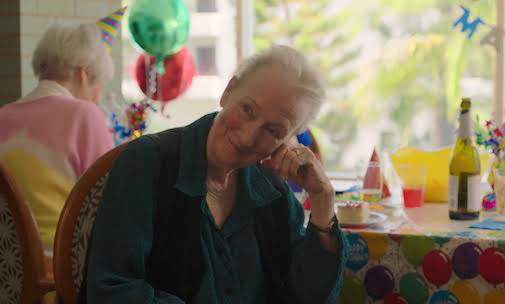
During Pinteresque silences with her son, the camera lingers in close-ups, especially on Ruth, as she struggles to come to terms with events. She is competent, gifted even, in matters of food preparation. In her earlier days, she had written books on the subject. Now, there is a stark difference between the skills she honed in the kitchen, and her ability to cope with life. There are huge gaps in her memory and understanding of which she is barely aware. She tries to convince staff at the care home of her good health and her ability to be independent.
The staff are, without exception, truly wonderful, talented, kind and caring professionals. One of them confesses to another that his own mother could not afford to be cared for here. Ruth’s appalling tragic circumstances are mitigated in this most positive of environments. One cannot help wondering about the predicaments of millions of other sufferers, worldwide, in more spartan surroundings with less gifted and beneficent staff.
The uncomfortableness deepens for the audience who see Ruth fantasising romantically, erotically, following the touch of the in-house doctor on her wrist as he takes her pulse. Even towards the film’s conclusion, Ruth behaves like a young woman looking for romantic fulfilment. In almost the final scene, her son visits the care home and dances with his mother. She holds onto him, blissfully, clutching him ever closer, as they dance and the music soars, implying a heart-warming ending.
But director Sarah Friedland, who also wrote the script, is too good for that. Dementia is unrelenting and progressive. There is no happy ending. Hence the sad, brutally honest short final scene. The film never stoops to melodrama. Its sense of realism is its power, along with the performance of Kathleen Chalfant.
As the credits go up, there are special thanks to residents and workers of the care home where it was filmed. One wonders which of the people we have been watching were to be thanked. Such was the excellence of this absorbing, convincing, unsettling and touching film. Friedland proves that with outstanding acting, an honest script, sensitive camerawork, sympathetic editing and a director’s feel for human suffering and emotion, the medium of film can throw light on the most difficult, wretched situations.Slight grimaces, a change in glance, a flicker of the lip, a gentle tilt of the chin, these carefully executed, superbly observed gestures take us through Ruth's indignation, hope, pleasure, confusion, hurt, anxiety and despair.