***
If only...
Bad Apples is like a football team that scores lots of goals, is good to watch, and entertains the crowd…. But the team's defence is so bad that it lets in plenteous goals at the other end and loses every game. Eventually, it is relegated, and forgotten. Such, sadly, is the likely fate of Bad Apples.
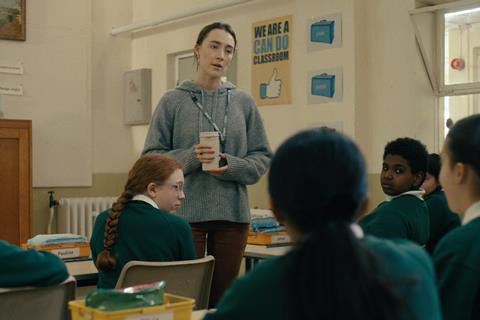
Danny, a year-six pupil, (creditably played by 15 year-old Eddie Waller) is violently disruptive in school. An imminent visit from Ofsted precipitates an almost slapstick, sometimes chilling sequence of events that leads to his class teacher Maria Spencer (Saoirse Ronan) locking him up in the basement of her flat. A neighbourhood and police hunt ensues to find the abducted child. Meanwhile, classroom life is calmer, Miss Spencer can get on with teaching, the pupils thrive and Ofsted pronounce the school ‘good with outstanding features’. Miss Spencer, the kind-hearted abductor, returns to her cellar at the end of each day to give private tuition to the outcast Danny whom she has restrained by a harness unwittingly brought to the her home by Danny’s delivery driver Dad, Josh (Robert Emms).
Not a few teachers will be relating to this tale. There are many pupils in schools who simply ought not to be there. They, and every other pupil, would benefit from a system that didn’t use the term ‘inclusivity’ as a mask for economic expediency. There is a scene, late in Bad Apples that is straight from the 2003 film School of Rock. At an evening meeting, parents having just discovered the truth about their children’s teacher, are initially outraged. Said teacher then draws attention to the flourishing talents, the latent genius of their offspring under the illicit regime. Job done. Parents converted. Illicit regime continues.
Several months into the abduction, Pauline the class creep – and she is unnervingly creepy - discovers Danny’s cellar and tells him that everyone in the class hates him, that they are all better off without him, and that the community feels that he must now be dead. Not for the first time, our sympathies are with Danny, struggling with a serious personality disorder, unable to read or write, unable to cope, assigned to a school system that is equally unable to cope.
Bad Apples has been labelled a 'dark comedy'. The word 'comedy' does not fit this bill, regardless of shade. In Shakespeare’s oeuvre, this is neither comedy nor tragedy. Like ‘Measure for Measure’ it’s a problem play. It raises the issue, probes the dilemmas via some memorable characters and touching scenes, but provides no solutions.
The great film that tackles this issue is yet to be made. Seriously disruptive children negatively affect the education of everyone in their class. Their angry tantrums are a cry for help. Some social problem films, like Cathy Come Home (1966) or Boys from The Blackstuff (1982), bite hard enough to energise change. Bad Apples does not. The 18th century satirist Jonathan Swift in 1729 proposed an outrageous solution to pervasive child-poverty in Ireland (A Modest Proposal). His tongue was in his cheek but his teeth were tiger-sharp. Bad Apples posits an outrageous solution, too. But it lacks the intellectual wit of A Modest Proposal. It’s a good idea, undeveloped.
Writer Jess O Kane, adapting his story from a Swedish novel De Oönskade (The Unwanted) needed to pay more attention to details of narrative to prevent the plot from looking about as watertight as a paper umbrella in a thunderstorm. The abduction is unlikely and the police response is glossed over. So are Danny's physical needs and condition. The love story between Maria and her Deputy Head colleague is weak and unnecessary. By the end of the film, one cannot help wondering why so little attention had been given to the police response, the search, the national media… details that would have given the story more credibility, more power, and less powderpuff.
.